
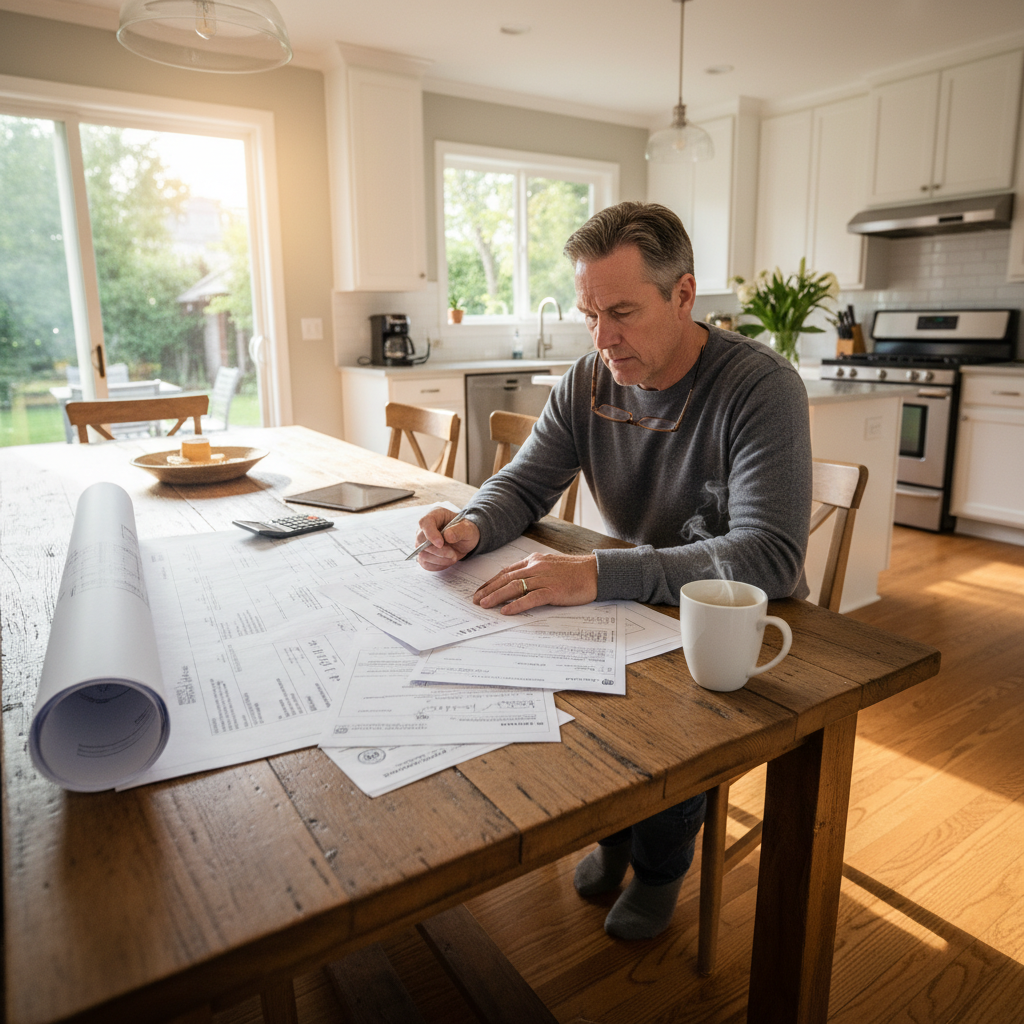
Permits are one of the most misunderstood parts of home remodeling. Homeowners hear “permit” and picture red tape, delays, and added cost. Contractors who want your business sometimes tell you permits aren’t necessary when they are. The result is unpermitted work that creates real problems — failed home sales, fines, mandatory demolition, and insurance complications — that cost far more than the permit ever would have.
This is a practical guide for DFW homeowners. What requires a permit in the Dallas-Fort Worth area, what doesn’t, what happens if you skip one, and how to navigate the permit process in the cities where most of our clients live.
Why Building Permits Exist
Building permits aren’t bureaucratic busywork. They exist to protect you. When a permit is pulled and inspections are passed, you have documentation that the work meets current building codes — codes that exist because houses without proper wiring catch fire, plumbing without proper venting causes sewer gas backups, and structural modifications without engineering review collapse.
Permits protect you in three specific ways:
Safety. An inspector catches problems before they’re buried in walls. Improper electrical work, missing waterproofing, undersized structural members — these are the things inspectors are trained to find.
Resale protection. Unpermitted work must be disclosed to buyers in Texas. Many lenders won’t finance homes with significant unpermitted improvements. Buyers can and do negotiate large price reductions — or walk away entirely — over unpermitted additions, converted garages, or structural changes.
Insurance coverage. If unpermitted work contributes to a loss — a fire from improper wiring, water damage from improper plumbing — your homeowner’s insurance may deny the claim. “Unpermitted” is a legitimate basis for claim denial.
What Requires a Permit in DFW Cities
Requirements vary by municipality, but across the major cities in the DFW metro — Dallas, Fort Worth, Duncanville, Cedar Hill, Midlothian, Mansfield, DeSoto, Lancaster, Burleson, Waxahachie — the following categories consistently require permits:
Structural Work
Any modification to your home’s structural system requires a permit without exception:
- Removing or altering load-bearing walls
- Adding or modifying headers, beams, or columns
- Room additions and bump-outs
- Garage conversions to living space
- Second-story additions
- Deck construction (attached or freestanding above a certain height — typically 30 inches off grade)
- Carports and patio covers attached to the house
- Foundation repair (in some municipalities)
If you’re not sure whether a wall is load-bearing, assume it is until a qualified contractor confirms otherwise.
Electrical Work
- New electrical panels or panel upgrades
- Adding new circuits
- Moving or adding outlets, switches, or light fixtures (in most DFW cities)
- Installing new ceiling fans requiring new wiring
- Hot tub and spa electrical connections
- EV charger installation
- Bathroom electrical work (GFCI requirements, exhaust fan wiring)
- Kitchen electrical updates when adding circuits
Note: Simple like-for-like fixture replacements — swapping one light fixture for another at the same location on an existing switch — generally don’t require a permit. Adding a new circuit or moving the location does.
Plumbing Work
- Moving or adding drain lines
- Relocating toilets, sinks, or showers to new locations
- Water heater replacement (required in most DFW cities)
- Adding a bathroom or half-bath
- Gas line modifications (always permitted — this is a safety issue with zero flexibility)
- Irrigation system installation (in many cities)
- Water softener installation connecting to main supply (varies by city)
Note: Replacing a faucet at an existing location, installing a new toilet at the same location, or replacing a showerhead are generally not permit-required.
HVAC Work
- New HVAC system installation or replacement (required across all major DFW cities)
- Adding new ductwork
- Moving supply or return air locations
- Installing mini-split systems
- Any gas appliance installation or connection
Roofing
This is where DFW homeowners are most commonly surprised. In many DFW cities — including Dallas, Duncanville, and Cedar Hill — a full roof replacement requires a permit. Requirements vary:
- Dallas: Permit required for new roof installation
- Fort Worth: Permit required for complete tear-off and replacement
- Duncanville: Permit required for roof replacement
- Midlothian: Permit required for new roofing
- Cedar Hill: Permit required for re-roofing
Roofing permits are relatively inexpensive ($50–$200 in most cities) and the inspection is straightforward. Any legitimate roofing contractor should be pulling permits. If a roofer specifically tells you they won’t pull a permit, that’s a red flag.
Siding
Full siding replacement typically requires a permit in most DFW cities, particularly when it involves sheathing or moisture barrier work. Fiber cement, vinyl, and engineered wood siding projects that involve removing existing siding and reinstalling new material generally require permits. Spot repairs to small areas often do not.
Fences
Fence permits are required in most DFW cities for new fence construction, though replacement of existing fences in-kind often doesn’t require one. Height limits apply — typically 6 feet in residential areas for rear and side yards, 4 feet for front yards. Always check with your specific city before building a fence.
What Typically Does NOT Require a Permit
Cosmetic work that doesn’t affect structure, systems, or building envelope generally doesn’t require permits:
- Interior painting — no permit needed
- Exterior painting — no permit needed
- Flooring replacement — hardwood, tile, carpet, LVP — no permit needed
- Cabinet replacement — provided no structural or plumbing changes
- Countertop replacement — no structural impact, no permit
- Fixture replacement in-kind — same location, same type
- Interior door replacement — non-structural, no permit
- Window replacement in-kind — same size opening, usually no permit (some cities require one for energy code compliance)
- Drywall patching and texture — no permit
- Insulation addition — usually no permit for adding attic insulation
- Replacing exterior light fixtures — in-kind replacement, no permit
The general rule: if you’re changing what’s there without altering the structure, electrical system, plumbing, or HVAC — you’re probably fine without a permit. When in doubt, call your city’s building department. The call is free, takes five minutes, and eliminates the risk.
The Real Consequences of Skipping Permits
The “I’ll save time and money by skipping the permit” calculation almost always fails when tested. Here’s how:
Failed Home Sale
This is the most common and expensive consequence. Texas requires disclosure of known unpermitted work. Buyers’ agents routinely pull permit history on homes — it’s public record. When unpermitted work is discovered, you face three options: disclose and negotiate a price reduction (often larger than the permit would have cost), pay to remediate the work and get it permitted retroactively (expensive), or lose the buyer.
Retroactive permits — sometimes called “as-built permits” — require exposing the work for inspection. If walls were already closed, they get opened. If ceilings were finished, they may need to be opened. The cost of remediation often runs 3–5x what the original permit would have cost.
Fines and Stop-Work Orders
Cities conduct inspections and receive complaints. Neighbors report unpermitted construction. Building departments drive through neighborhoods and spot obvious additions. If your city issues a stop-work order or violation notice, you’re paying fines plus doing the remediation work.
Fines in DFW cities typically run $100–$500 per day per violation until resolved. A protracted dispute can result in thousands in fines before the issue is closed.
Insurance Denial
As mentioned above, unpermitted improvements that contribute to a covered loss create legitimate grounds for claim denial. A kitchen fire caused by unpermitted electrical work, or water damage from unpermitted plumbing, can result in your insurer refusing coverage for the loss.
Safety Risk
This is obvious but worth stating plainly: improperly installed electrical wiring causes house fires. Improper plumbing causes mold, structural damage, and sewer gas exposure. Building codes exist because these failures happen — and they’re preventable.
How to Get a Permit in Major DFW Cities
The permit process has become significantly more accessible in most DFW cities, with online portals that allow application, payment, and scheduling without in-person visits.
General Process
- Application. Submit project description, property address, scope of work. Larger projects (additions, structural changes) require submitted plans.
- Plan review. For complex projects, plans go to a reviewer. Turnaround varies: Duncanville runs 5–10 business days, Dallas can run 2–4 weeks for complex projects.
- Permit issuance. Pay fees, receive permit. Permit must be posted on site (or available for inspection).
- Inspections. Inspectors visit at defined stages — rough-in before walls are closed, final after completion. You schedule these through the city.
- Final approval. Project receives final sign-off. Documentation is recorded.
City-Specific Resources
- Dallas: dallascityhall.com — Building Inspection Department, online permits through eTRAKiT portal
- Fort Worth: fortworthtexas.gov — Development Services, online permit center
- Duncanville: duncanvilletx.gov — Building Inspections, (972) 780-5000
- Cedar Hill: cedarhilltx.com — Building Inspections
- Midlothian: midlothian.tx.us — Development Services
- Mansfield: mansfieldtexas.gov — Building Inspections
- DeSoto: desotocityhall.com — Building Services
Permit Fees
Permit fees in DFW are generally calculated as a percentage of project value or on a flat-rate schedule. Typical ranges:
- Roofing permit: $50–$200
- Water heater replacement: $50–$100
- HVAC replacement: $75–$200
- Bathroom remodel (plumbing/electrical): $150–$400
- Kitchen remodel: $200–$600
- Room addition: $500–$2,000+ depending on square footage
These are small numbers relative to the project cost and the potential consequences of skipping them.
What to Expect From a Legitimate Contractor
Any contractor who is licensed and operating above-board will pull permits as a matter of course. They should:
- Discuss permit requirements during the estimate phase
- Include permit fees in the project cost (or quote them separately and transparently)
- Handle the permit application and scheduling
- Coordinate inspection timing with the project schedule
- Provide you with permit documentation when the project closes
At Golden Construction DFW, we pull permits on every project that requires one — no exceptions. Owner Samuel Diaz can be reached at (945) 332-3044 if you have questions about what your specific project requires before you commit to a scope.
If a contractor tells you permits “aren’t necessary” for work that typically requires one, or offers a lower price “if we skip the permit,” walk away. You’re the one who owns the house. You’re the one who will deal with the consequences.
The Bottom Line
Building permits in the DFW area are not optional for structural, electrical, plumbing, HVAC, roofing, and siding work. They exist to protect your safety, your investment, and your ability to sell the home. The permit process has become more efficient in most DFW cities — most projects can be permitted online with minimal friction.
The math is simple: a permit costs a few hundred dollars and a few weeks of coordination time. Unpermitted work discovered during a home sale, insurance claim, or city inspection costs multiples of that in price concessions, remediation, and fines. Do the work right the first time.