Choosing siding for a Texas home is not the same decision as choosing siding for a home in Vermont or Oregon. Texas has its own set of climate conditions that expose siding to extraordinary stress year after year: summer temperatures that push past 110°F on south-facing walls, ultraviolet radiation that fades and degrades materials faster than almost anywhere in the country, hailstorms that arrive without warning and at velocities that destroy lesser materials, termite pressure that’s among the highest in the nation, and humidity cycles that cause expansion and contraction that eventually breaks down certain materials at their joints and seams.
Fiber cement siding — particularly James Hardie products, which are engineered to regional climate requirements — addresses every one of these conditions more effectively than vinyl, wood, engineered wood, or stucco. Here’s an honest breakdown of why.
What Fiber Cement Siding Is
Fiber cement is a composite material made from Portland cement, sand, and cellulose fibers (wood pulp). The manufacturing process creates a dense, dimensionally stable board that’s chemically inert to most of what Texas weather throws at it. It’s not soft like wood, it’s not brittle like traditional stucco, and it doesn’t flex and deform like vinyl under thermal stress.
James Hardie — the dominant brand in the fiber cement market — manufactures products specifically calibrated for regional climates. Their HardieZone system produces two product lines: HZ5 for cold climates and HZ10 for hot and humid climates — which is exactly what Texas is. HZ10 products are formulated to resist moisture in warm climates, resist UV degradation at high temperatures, and resist the cracking that occurs when materials expand dramatically in summer heat.
When we install James Hardie siding on DFW homes, we’re installing a product that was literally engineered for this climate.
Durability: Built for the Long Term
Fiber cement siding has a life expectancy of 50+ years when properly installed and maintained. That’s not a marketing claim — it’s a function of what the material is. Cement doesn’t rot. Sand doesn’t degrade under UV. Cellulose fibers in proper proportion give flexibility without introducing biological vulnerability.
Compare that to:
- Vinyl siding: Life expectancy of 20–30 years, with significant degradation in color and impact resistance starting at 15 years in Texas sun
- Wood siding: Life expectancy of 20–40 years with consistent maintenance; requires repainting every 5–7 years, vulnerable to rot, insects, and moisture
- Engineered wood (LP SmartSide, etc.): 30+ year warranty but susceptible to moisture infiltration at cut edges and in high-humidity conditions
- Stucco: Can last decades but requires careful installation and is vulnerable to cracking in Texas’s thermal expansion cycles
Fiber cement occupies a tier above these alternatives in raw durability. The 30-year manufacturer warranty on James Hardie products reflects material confidence that no vinyl manufacturer can match.
Impact and Hail Resistance
DFW is part of what meteorologists call “Hail Alley” — the corridor stretching from Texas through Oklahoma and Kansas that receives more large hail events than anywhere else in the world. DFW averages multiple significant hailstorms per year. Hail at 1.5 inches in diameter (golf ball range) causes significant damage to vinyl siding — cracking panels, creating entry points for moisture, and destroying the aesthetic integrity of an exterior within a single storm.
Fiber cement siding handles hail dramatically better. Its density and rigidity absorb impact without cracking or puncturing under hail up to 1.75 inches. James Hardie products carry Class 4 impact ratings — the highest available — from insurance testing laboratories. Many Texas homeowners with fiber cement siding receive premium discounts of 15–30% on homeowner’s insurance for this reason.
That insurance discount is worth calculating against your installation cost. If your annual premium is $2,400 and you receive a 20% discount, that’s $480 per year — nearly $5,000 over 10 years — coming back to you in insurance savings alone.
Wind resistance is equally strong. James Hardie products are rated to withstand wind speeds exceeding 150 mph when properly installed. Texas doesn’t typically see wind speeds that extreme outside of tornadoes, but the rating reflects a product that won’t come off in the 70–90 mph gusts that accompany severe thunderstorms in DFW.
Fire Resistance
Fiber cement is non-combustible. It doesn’t burn. It won’t contribute to a fire spreading from an exterior ignition source — a wildfire ember landing on your siding, a fire starting at a neighbor’s property, a grill left too close to the exterior wall. It carries a Class A fire rating, the highest available.
This matters more in Texas than homeowners sometimes realize. Urban interface fires in Texas have become more frequent as development has expanded into areas with natural vegetation. Home ignitions from exterior fire sources — embers landing on combustible siding or soffit materials — account for a significant share of structure losses in these events.
Vinyl siding burns and melts. Wood siding burns readily. Fiber cement does neither. For homeowners in newer DFW-area developments that back to greenbelt areas, creek corridors, or open land, this is a meaningful safety advantage.
Termite Resistance
Texas has severe termite pressure — particularly Formosan termites, which are larger, more aggressive, and more destructive than native subterranean termite species. Formosan colonies can number in the millions and consume wood at rates that cause structural damage within months of infestation.
Fiber cement siding provides no nutritional value to termites. Cement and sand don’t digest. While termites can technically travel across fiber cement siding to reach structural wood framing behind it, they can’t damage the siding material itself. Compare this to wood siding — including engineered wood — which termites can and do consume aggressively, and which creates pathways directly to structural members.
Fiber cement siding eliminates one potential vulnerability in the termite pathway. Combined with a termite prevention program and proper moisture control, it significantly reduces exterior termite risk.
Moisture and Rot Resistance
Texas has dual moisture challenges that most homeowners underestimate. Coastal and eastern parts of DFW see genuine humidity — 60–80% relative humidity is common in spring and early summer. But even western DFW sees significant moisture stress from temperature cycling: cool nights cause condensation, hot days cause rapid drying, and this repeated wet-dry-wet cycling degrades organic materials over time.
Fiber cement is dimensionally stable in moisture. It doesn’t swell, warp, buckle, or delaminate when wet. Properly installed with appropriate moisture barriers and flashing, it prevents water intrusion without absorbing water itself.
This is a meaningful contrast with engineered wood siding, which can absorb moisture at unprotected cut edges and swell or delaminate over time. It’s also a contrast with wood siding, where moisture infiltration at joints, knots, and end cuts eventually leads to rot that must be caught early to prevent structural damage.
James Hardie’s ColorPlus factory-finish technology adds a baked-on acrylic coating that further limits moisture absorption and eliminates the need for repainting on the painted-surface schedule that field-painted or stained wood requires.
UV and Heat Resistance
South-facing walls in Texas receive extraordinary ultraviolet radiation exposure. Vinyl siding fades noticeably within 10–15 years on south-facing walls — the color difference between sun-facing and shaded sides of a home becomes obvious and is impossible to correct short of full replacement.
Fiber cement siding, particularly with James Hardie’s ColorPlus factory-applied finish, resists UV fading dramatically better than vinyl. The paint system is applied in a controlled factory environment, baked on at high temperature, and includes UV inhibitors that field-applied exterior paints simply can’t match. James Hardie warrants the ColorPlus finish for 15 years against peeling, cracking, and chipping.
Even after the factory finish requires repainting — typically at the 15–20 year mark — the underlying substrate is unchanged. You’re repainting over a solid, stable, fully intact surface. This is categorically different from trying to restore faded vinyl, which can’t be painted successfully long-term.
Thermal expansion is another heat-related consideration. Vinyl expands and contracts substantially with temperature changes — Texas summer-to-winter temperature swings of 80°F or more create significant dimensional movement at joints and corners. Over time, this movement loosens joints and creates gaps. Fiber cement has a much lower thermal expansion coefficient, meaning it moves far less and maintains tighter joints over its service life.
Energy Efficiency
While siding itself is not a primary insulator, fiber cement siding installations can improve a home’s overall thermal envelope in two ways:
Elimination of thermal bridging at gaps and joints. Vinyl siding that has expanded and contracted thousands of times may develop small gaps at joints and corners that allow air infiltration. Fiber cement maintains tighter joints over time, reducing air infiltration.
Compatibility with continuous insulation. Fiber cement siding is installed over a wall system that can include continuous exterior rigid insulation — a layer of polyisocyanurate or XPS foam between the sheathing and the siding. This thermal break dramatically reduces wall assembly thermal bridging and can improve whole-wall R-values from R-15 to R-20+. Not all siding materials accommodate continuous insulation as cleanly as fiber cement.
In Texas, where cooling loads dominate energy costs, reducing solar heat gain on wall assemblies matters. Fiber cement’s paint system on south and west walls can be selected in colors that reflect more solar radiation, reducing wall surface temperatures and heat conduction into conditioned space.
Curb Appeal and Design Options
None of the above durability advantages matter if the material looks cheap or limits your design options. Fiber cement doesn’t.
James Hardie produces siding in profiles that replicate every traditional exterior look:
- HardiePlank lap siding — the classic horizontal siding look, available in smooth or wood-grain texture
- HardieShingle — cedar shake and shingle appearance without organic vulnerability
- HardiePanel vertical siding — board-and-batten profiles for farmhouse and contemporary styles
- HardieTrim — matching trim boards for corners, windows, fascia, and decorative elements
The factory ColorPlus finish is available in over 700 colors, pre-matched to the most popular exterior paint palettes. Every board is factory-cut to the same profile, ensuring visual consistency that hand-milled wood can’t guarantee.
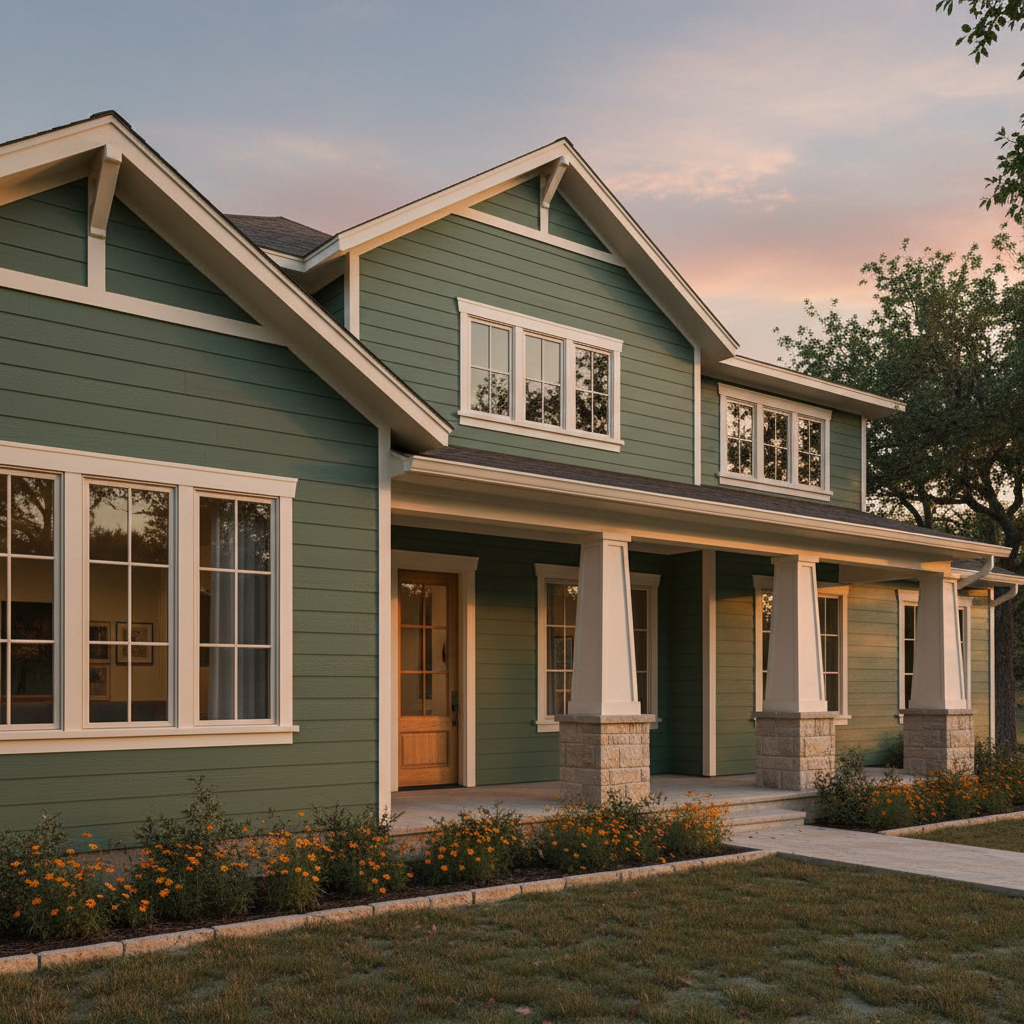
For DFW homeowners who want a specific aesthetic — traditional, contemporary, farmhouse, craftsman — fiber cement can deliver it without the maintenance compromises of natural materials.
What Fiber Cement Installation Requires
Fiber cement is not a DIY material, and it’s not a product for siding crews who haven’t worked with it before. It’s significantly heavier than vinyl or engineered wood — a full board of HardiePlank weighs 4–5 times what a comparable vinyl panel does. Cutting requires fiber cement-specific blades or shear cutting tools to avoid generating hazardous silica dust. Installation requires proper fastening patterns, moisture barrier systems, and flashing details that differ from vinyl installation.
Improper installation — missed flashing, improper nailing, gaps at penetrations — voids the manufacturer warranty and can allow moisture intrusion that causes the very problems fiber cement is designed to prevent.
James Hardie’s preferred installer program certifies contractors who have completed specific training in proper installation techniques. Golden Construction DFW installs James Hardie products across Duncanville, Cedar Hill, Midlothian, Mansfield, and the surrounding DFW communities. If you’re comparing siding options for your home or want to understand what a fiber cement installation would involve, call Samuel Diaz at (945) 332-3044 for a free assessment.
The Bottom Line
Fiber cement siding is the best-performing exterior cladding product available for Texas homes by nearly every metric that matters in this climate: hail resistance, fire resistance, termite resistance, UV resistance, moisture stability, and longevity. The upfront cost is higher than vinyl — typically 30–50% more installed — but the lifecycle cost is lower when you account for longer service life, reduced maintenance, insurance savings, and the complete elimination of the premature replacement cycle that vinyl and wood eventually require.
For DFW homeowners thinking about siding replacement, fiber cement isn’t just a good choice. In a climate that tests everything you put on the outside of your house, it’s the right choice.