
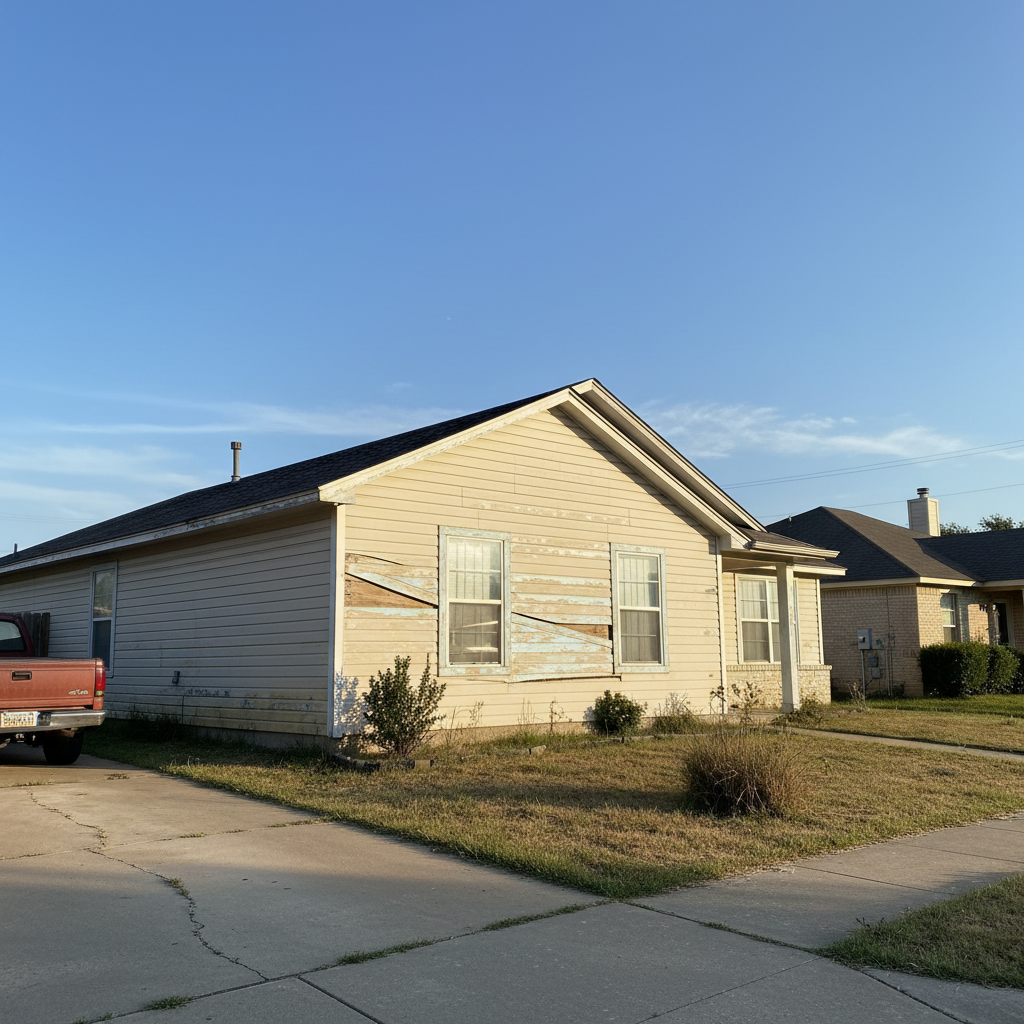
Most homeowners don’t think about their siding until something goes visibly wrong — a panel blowing off in a storm, a soft spot that gives when you press it, or a neighbor mentioning that the south side of the house is looking rough. By the time siding gets to that point, the damage usually isn’t just cosmetic.
I’ve been replacing siding on DFW homes since 1999. In that time, I’ve seen what happens when homeowners wait too long: moisture gets behind the cladding, OSB sheathing rots, and what would have been a $15,000 siding job becomes a $22,000 job because we’re also replacing structural sheathing and reframing sections of wall. North Texas weather is particularly unforgiving — the combination of heat, UV intensity, hail, and dramatic humidity swings accelerates siding degradation faster than most people realize.
Here’s what to look for so you’re not caught off guard.
1. Warping, Buckling, or Panels Pulling Away from the Wall
Healthy siding lies flat against the wall and locks together at the seams. When you start seeing panels bow outward, buckle in the middle, or pull away at the edges, that’s a structural failure — not just cosmetic wear.
For vinyl siding, warping typically happens because the material expanded in extreme heat and had nowhere to go. Surface temperatures on south- and west-facing walls in DFW routinely exceed 160°F on summer afternoons. Vinyl begins to soften around 165°F, so even quality panels can distort over time. Once a panel warps, it no longer creates a weathertight seal. Water gets in behind it.
For wood or fiber cement, warping usually indicates moisture has penetrated somewhere — often at an unsealed joint, around a window or door, or at the bottom course where it’s close to soil or mulch.
What to do: Run your hand along warped sections and feel for soft spots behind the panel. If the wall feels spongy, moisture is already in the sheathing. That’s a replacement situation, not a repair.
2. Visible Cracking, Chipping, or Brittleness
Fiber cement and vinyl both crack, just for different reasons and at different points in their lifespan.
Vinyl cracking most often happens after a hail event or after years of UV exposure make the PVC brittle. Spring and fall hailstorms hit when temperatures are in the 40s and 50s — exactly when vinyl is at its most brittle. A hailstone that would dent aluminum or chip paint off fiber cement can shatter a vinyl panel at those temperatures.
Fiber cement cracking typically appears at cut edges that weren’t properly sealed, at nail penetrations where fasteners were driven too hard, or in older installations where the original primed-only finish was never repainted on schedule. Unprotected fiber cement absorbs moisture at cut edges and eventually splits.
Small cracks on one or two panels can sometimes be repaired. Widespread cracking across multiple elevations is a sign the entire installation is failing. In hail-heavy areas like Midlothian, Mansfield, Cedar Hill, and Duncanville, I rarely see hail damage that stops at a few isolated panels — it usually affects the whole house.
3. Fading That Won’t Come Clean
All siding fades over time. That’s normal. The problem is when fading becomes so severe that the original color is unrecognizable, or when cleaning with a pressure washer or siding cleaner doesn’t restore any of the appearance.
Heavy fading on vinyl means the UV stabilizers in the PVC are exhausted. At that point, the material is degrading at a molecular level — it’s not just a color problem, it’s a sign that the material is becoming brittle and losing its weather resistance.
Faded fiber cement with a factory finish that’s peeling, chalking, or flaking needs to be repainted — but that’s maintenance, not replacement. The distinction matters. If the substrate is otherwise sound, a fresh coat of 100% acrylic exterior paint buys years. If the fading is paired with cracking, soft spots, or moisture damage, you’re looking at replacement.
DFW’s UV index regularly hits 10–11 during summer months, which is classified as “very high” to “extreme” exposure. That’s similar to what you’d see in Arizona or New Mexico. Siding that performs fine in Ohio may fail prematurely here.
4. Moisture Damage, Soft Spots, or Bubbling
This is the one that scares me most on inspections, and the one I see homeowners ignore longest because it’s often hidden.
Moisture damage behind siding can develop for years before it shows on the surface. When it does show, the signs include:
- Bubbling or blistering paint on the siding surface — water vapor is pushing up through the paint film from behind
- Soft spots when you press on the panel — the sheathing behind it is wet or already rotting
- Water stains at the bottom of walls or along horizontal seams
- Staining on interior drywall in rooms adjacent to exterior walls — an advanced sign that moisture has moved through the wall assembly
- Musty smell inside the house with no obvious interior moisture source
Moisture infiltration usually traces back to failed flashing around windows and doors, missing or deteriorated caulk at seams and penetrations, or siding that was installed too close to grade (the bottom course should be at least 6 inches above soil and 2 inches above hard surfaces).
Once sheathing is wet, rot follows quickly in North Texas’s summer heat. A rotted wall section can compromise structural integrity and creates ideal conditions for mold growth inside the wall cavity — which brings us to the next sign.
5. Mold, Mildew, or Fungal Growth
Finding mold on the surface of siding isn’t automatically an emergency. In shaded, humid areas — under eaves, on north-facing walls — mildew can grow on the exterior surface of otherwise healthy siding. A bleach-and-water solution or a pressure wash usually clears it.
Mold inside the wall is a different story entirely.
If you’re seeing mold on the interior surface of an exterior wall, or if a surface cleaning reveals that mold keeps coming back within weeks, moisture is likely trapped inside the wall assembly. That’s not a cleaning problem. Siding has to come off to dry out the wall, treat the sheathing, and find the source of intrusion.
In DFW’s humid summers, mold can establish and spread rapidly once it has a moisture source. I’ve opened up walls on homes in Duncanville and Cedar Hill where the exterior looked borderline acceptable but the sheathing behind it was black with mold across a 40-square-foot section. The homeowners had no idea.
6. Noticeably Higher Energy Bills
Your siding is part of the building envelope — the system that separates conditioned interior air from the outdoors. When siding fails, that envelope develops gaps, and conditioned air leaks out while outdoor air leaks in.
This matters enormously in DFW, where June, July, and August routinely bring weeks of 100°F+ temperatures. If your HVAC system is running longer cycles than it used to, your energy bills are climbing without any change in how you’re using the house, or you’re noticing hot spots on interior walls during summer, deteriorating siding may be contributing.
Failed siding doesn’t insulate differently than new siding — but it allows air infiltration at gaps, cracks, and failed seams that didn’t exist when the material was new. On a 2,500 sq ft home, that air infiltration can meaningfully increase cooling loads.
This is rarely the sole reason to replace siding, but when it appears alongside other warning signs, it confirms that the building envelope has been compromised.
7. Frequent Maintenance or Repeated Repairs
If you’ve paid to repair or patch your siding twice in five years, you’re probably throwing money at a problem that’s going to keep coming back.
Some homeowners think they’re being frugal by patching rather than replacing. In reality, patchwork repairs on aging siding rarely hold for long — especially after hail, which can cause widespread low-level damage that manifests slowly over the following year or two. Panels that looked fine after a storm may begin failing 18 months later as micro-cracks allow moisture in and the freeze-thaw cycle (yes, DFW does occasionally freeze) expands those cracks.
If you’re replacing multiple panels every year, getting the same section recaulked over and over, or painting over the same blistering area on an annual basis, the honest math is that replacement would cost less over a five-year window than continued repairs.
DFW-Specific Weather Factors That Accelerate Siding Failure
The DFW metroplex is one of the more challenging environments for exterior cladding in the country. A few factors worth understanding:
Hail frequency. Dallas and Tarrant counties average 10–14 significant hail events per year. Multiple 1-inch hail events over a siding’s lifetime — even without a single catastrophic storm — add up to cumulative stress fractures that aren’t always visible from the ground.
Thermal cycling. We regularly see 40°F temperature swings within a 24-hour period in spring and fall. Every heating and cooling cycle causes siding material to expand and contract. Over years, this fatigues the material at seams and fasteners.
UV intensity. DFW receives significantly more UV exposure than northern states. UV degrades polymers (vinyl), oxidizes paint films, and breaks down the surface integrity of fiber cement if the paint system isn’t maintained.
Wind-driven rain. Severe thunderstorms in North Texas frequently produce horizontal rain at 40–60 mph. Water that drives horizontally can infiltrate gaps that would be fine in normal vertical rain — particularly around windows, at inside corners, and at horizontal seams.
When to Get an Inspection vs. When to Start Budgeting for Replacement
Not every warning sign means you need to replace everything tomorrow. Here’s a rough guide:
Get an inspection if you’re seeing:
- One or two cracked or damaged panels in an isolated area
- Surface mold or mildew
- Minor fading
- Slightly elevated energy bills without other obvious causes
Start budgeting for replacement if you’re seeing:
- Warping or buckling across more than one elevation
- Soft spots indicating moisture behind the panels
- Mold growth that keeps returning after cleaning
- Cracking or shattering after a hail event
- Multiple failed repair attempts on the same areas
- Any sign of moisture on interior walls adjacent to exterior
Get a Straight Answer Before You Spend Money on Repairs
One thing I’ve always done for homeowners in the DFW area is a free exterior inspection — not a sales pitch, but an honest assessment of whether what you’re seeing is repairable or whether you’d be wasting money patching a failing system. Sometimes the answer is: patch the two bad panels and seal around that window, and you’re fine for another 5 years. Other times it’s: we need to pull this off and start over.
I’d rather tell you the truth than sell you a job you don’t need — and I’d rather catch a moisture problem early than have you call me back in two years with a six-figure water damage claim.
Call Golden Construction DFW at (945) 332-3044 to schedule your free siding inspection. We serve Duncanville, Cedar Hill, DeSoto, Midlothian, Mansfield, Waxahachie, and surrounding DFW communities. You can also request your inspection online anytime.